How to Choose a Good Secure & Unbreakable Password ?


How to Choose a Good Secure & Unbreakable Password ?Choosing a secure password is one of the most important parts of setting up any type of online account. If someone breaks into your account and changes your password and email address, they will have effectively stolen your stuff and you will be unable to get it back. The following is some advice on choosing your password.

What NOT to Do
The following things should not be used as your password, or even as a part of it:

  • Your username.
  • Your real name.
  • Any name at all.
  • Your birthday, phone number, address or social security number.
  • Any dictionary word, in any language.
  • Dictionary words with common number/letter substitutions, such as zeros for the letter O, ones for the letter L, 3's for E, etc.
  • Any of the sample passwords you find here or elsewhere on the internet.

Some Good Suggestions
These are some ideas that will help you create a good password and keep it safe:

  • Include punctuation marks, such as .,!@# etc.
  • Use a mix of capital and lowercase letters.
  • Make your password at least 8 characters long. The longer it is, the more secure it will be.
  • Choose an interesting phrase, a line from a poem, or a section of song lyrics. Then use the first letter from each word to construct your password. Make sure you don't accidentally create dictionary words this way!
  • Go to a busy street or parking lot and write down the first three or four liscense plates you see. Remove the duplicate letters and numbers and make your password from the remaining ones.
  • Find other ways of getting random letters and numbers, such as opening books and taking the third letter from the first ten nouns you see. Be creative!

An Example
Let's create a good password, just to show you one example of the process:

  • We'll start with a line from Lewis Carroll's poem Jabberwocky: Twas brillig, and the slithy toves did gyre and gimble in the wabe.
  • Now, let's take the second letter from each word: wrnhloiyninha.
  • There are some duplicate letters in here, so we might want to replace them with numbers and/or other symbols, like this: wrnhloiy!3%7a.
  • Just for fun, let's capitalize the letters that came from adjectives: wRnhLoiy!3%7a.
  • The result is a pretty weird looking but hard to break password: wrnhloiy!3%7a. It also has an added advantage, which is that we used a system of sorts to create it, so we'll have a chance of figuring it out again if we forget it. When you create your own password, you can make up a system like this that might be easier for you to remember.

Keeping Your Password Safe

  • Never tell anyone your password.
  • Never write your password down. Even though your password will look random to others, you should have a way to easily remember it yourself so that you do not have to write it down.
  • Change your password every few months.

A nice image...
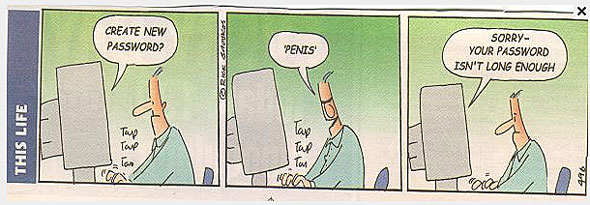
http://www.megaleecher.net/uploads/computer_password.jpg

Read full Article...

What do People Search for on google,yahoo etc ??


Millions of searches are conducted each day on popular search engines by people all around the world. What are they looking for? A number of major search engines provide a way to glimpse into the web's query stream to discover the most popular search keywords or topics. These are:

  • AOL Hot Searches: Top current queries, or see those in the last hour, last day and within particular categories.
  • Ask IQ: See top searches at Ask.
  • Dogpile SearchSpy: Choose to see either a filtered or non-filtered sample of top, real-time search terms from this popular meta search service. Sister site MetaCrawler offers a similar MetaCrawler MetaSpy service.
  • Google Trends: Allows you to tap into Google's database of searches, to determine what's popular. View the volume of queries over time, by city, regions, languages and so on. Compare multiple terms, as well. See our review: Google Trends: Peer Into Google's Database Of Searches.
  • Google Zeitgeist: What people are searching for at Google and its associated specialty services in a variety of categories. There are versions for various countries, as well.
  • Lycos 50: Long-standing service showing top searches at Lycos each week.
  • MSN Search Insider: Top 200 queries on MSN Search (annoyingly in random order), top "movers" in TV, sports and music, and a "duels" feature pitting top queries in a race against each other.
  • Yahoo Buzz Index: Shows you what's hot and what's not in terms of search topics at Yahoo.
A nice Image

Read full Article...

English Is a Funny Language : See What most people Say ??


http://www.vnstt.com/News/ImageUp/U1_The%20Funny%20English%20Language.jpgWell, I found This Great Article my friend Emailed Me... Have a look..

Here it goes :
There is no egg in eggplant nor ham in hamburger; neither apple nor pine in pineapple... English muffins were not invented in England or French fries in France. Sweetmeats are candies, while sweetbreads, which aren't sweet, are meat.

We take English for granted. But if we explore its paradoxes, we find that quicksand can work slowly, boxing rings are square, and a guinea pig is neither from Guinea nor is it a pig.

And why is it that writers write, but fingers don't fing, grocers don't groce, and hammers don't ham? If the plural of tooth is teeth, why isn't the plural of booth beeth? One goose, 2 geese. So, one moose, 2 meese? One index, two indices? Is cheese the
plural of choose?

If teachers taught, why didn't preachers praught? If a vegetarian eats vegetables, what does a humanitarian eat?

In what language do people recite at a play, and play at a recital?

Ship by truck, and send cargo by ship? Have noses that run and feet that smell? Park on driveways and drive on parkways?
How can a slim chance and a fat chance be the same, while a wise man and a wise guy are opposites? How can the weather be hot as hell one day and cold as hell another?

When a house burns up, it burns down. You fill in a form by filling it out, and an alarm clock goes off by going on.

When the stars are out, they are visible, but when the lights are out, they are invisible. And why, when I wind up my watch, I start it, but when I wind up this essay, I end it?

Anyways, If you thought, you were really good at English, especially in your pronunciations, then how about giving this a shot?

  1. The bandage was wound around the wound.
  2. The farm was used to produce produce.
  3. The dump was so full that it had to refuse more refuse .
  4. We must polish the Polish furniture.
  5. He could lead if he would get the lead out.
  6. The soldier decided to desert his dessert in the desert.
  7. Since there is no time like the present, he thought it was time to present the present.
  8. A bass was painted on the head of the bass drum.
  9. When shot at, the dove dove into the bushes.
  10. I did not object to the object.
  11. Insurance was invalid for the invalid.
  12. There was a row among the oarsmen about how to row.
  13. They were too close to the door to close it.
  14. The buck does funny things when the does are present.
  15. A seamstress and a sewer fell down into a sewer line.
  16. To help with planting, the farmer taught his sow to sow.
  17. The wind was too strong to wind the sail.
  18. Upon seeing the tear in the painting I shed a tear.
  19. I had to subject the subject to a series of tests.
  20. How can I intimate this to my most intimate friend?

So, were they all perfect?

A Nice Image :

Read full Article...

The History of Google : How It all Began ?


The History of Google : How It all Began ?It all began in the summer of 1995, when Larry Page and Sergey Brin met at Stanford University (Brin showed Page around the school). The two students founded Google - named after googol, the term for 1 followed by 100 zeros - a year later in a suburban garage. It was incorporated on September 7 1998 - which became Google's birthday.
Google's headquarters
The future's bright, the future's Google ... Google's headquarters

With millions using Google every day, it is regularly voted one of the world's top brands. Page and Brin have been described as the Thomas Edisons of the internet. But some worry that it has become a major threat to privacy. Google's tentacles are everywhere.It runs services for blogging, email, instant messaging, shopping and social networking. It also offers a suite of word processing, spreadsheet and other tools to rival Microsoft's products in the workplace, and is building a software platform for mobile phones that may challenge Apple's iPhone and others.

Recently, Google launched Chrome, a new web browser, opening up another front in its battle with Microsoft.

Google was also accused of selling out and reneging on its "Don't be evil" motto when it launched in China in 2005. The company modified the version of its search engine in China to exclude controversial topics such as the Tiananmen Square massacre or the Falun Gong movement, provoking a backlash in its core western markets.

Its founders admitted last year that the decision to censor its search engine in China was bad for the company.

Timeline

1995
· Larry Page and Sergey Brin meet at Stanford University

1996
· Now computer-science students, Page and Brin begin collaborating on a search engine called BackRub, named for its ability to analyse website backlinks for relevance

· The first version of Google is released on the Stanford University website in August

1997:
· Google.com is registered

1998

· An unincorporated Google Inc receives its first investment: $100,000 (£56,000) from Sun co-founder Andy Bechtolsheim

· Google sets up a workspace in a garage in Silicon Valley

· Google files for incorporation in California, granted on September 7 - now celebrated as Google's birthday

1999
· Google outgrows its garage office and moves to an office with eight employees

· The company gets $25m of venture capital and moves to Mountain View

2000
· The first 10 language versions of Google.com are released: French, German, Italian, Swedish, Finnish, Spanish, Portuguese, Dutch, Norwegian and Danish

· Does a deal with Yahoo to become its default search provider

· Google becomes the world's largest search engine with the first billion-URL index

2001
· In its first public acquisition Google buys Deja.com's Usenet Discussion Service, an archive of 500m discussions dating back to 1995

· Eric Schmidt becomes chairman, then chief executive

· Page and Brin are appointed presidents of products and technology, respectively

2002
· Major partnership with AOL

· Google News launched, with 4,000 sources

2003
· American Dialect Society members vote "google" the most useful word of the year for 2002

· Acquires Pyra Labs, the creators of Blogger

2004
· Gmail launched

· Google goes public: IPO at $85 a share

· Partnerships announced with leading libraries and universities to digitally scan millions of books from their collections

2005
· Google Maps and Google Earth launched, a satellite imagery-based mapping service, followed by Google Talk

2006
· Google goes live in China

· Acquires video-sharing site YouTube

2007
· Street View in Google Maps debuts in five US cities

· Acquires DoubleClick, an online advertising company

2008
· New Yahoo partnership announced

· Real-time stock quotes go live on Google Finance for the first time

· Belgian newspapers push for up to €49m (£39.4m) in damages from Google for publishing and storing their content without paying or asking permission

· Surprise launch of new web browser Chrome in September.


Copied from : Here

Read full Article...

The First Post of This Blog


Hi there. Welcome to the very last post in this blog - at least if you're reading the posts in reverse-chronological order the way they're presented by default. Silly, eh ?
The First Post of This Blog

Read full Article...

copyarticle article and content policies


Read full Article...

submit


text

Read full Article...

contact me


text

Read full Article...

About This Blog


Text

Read full Article...

Followers


Copy Articles Copyright 2008

Copy Articles © Copyright 2008 All Rights Reserved. | Revolution Two Church theme by Brian Gardner.